1% TDS on crypto in India, explained with a calculator
By BtcMedia Research · Updated · How we source
Every time you sell crypto in India above a small yearly threshold, 1% of the sale value is held back as tax deducted at source (TDS). It is not an extra tax, but for anyone who trades often it quietly ties up a surprising share of their capital until they file a return. Here is the rule, sourced, and the maths most explainers skip.
1% TDS on crypto calculator
See how much 1% TDS is deducted across your sales in a tax year, and how much trading cash it locks up until you claim it back in your return.
- Total sale value
- —
- TDS deducted in the year
- —
- Cash locked until you file & get credit
- —
- Trading capital left
- —
Not tax advice. An educational estimate for a resident seller. It assumes flat prices and ignores fees, gains tax and surcharge. TDS is a credit, not an extra tax: it is set against your final tax or refunded after your return is processed. Check your annual tax statement and ask a chartered accountant for your own case.
What the rule says
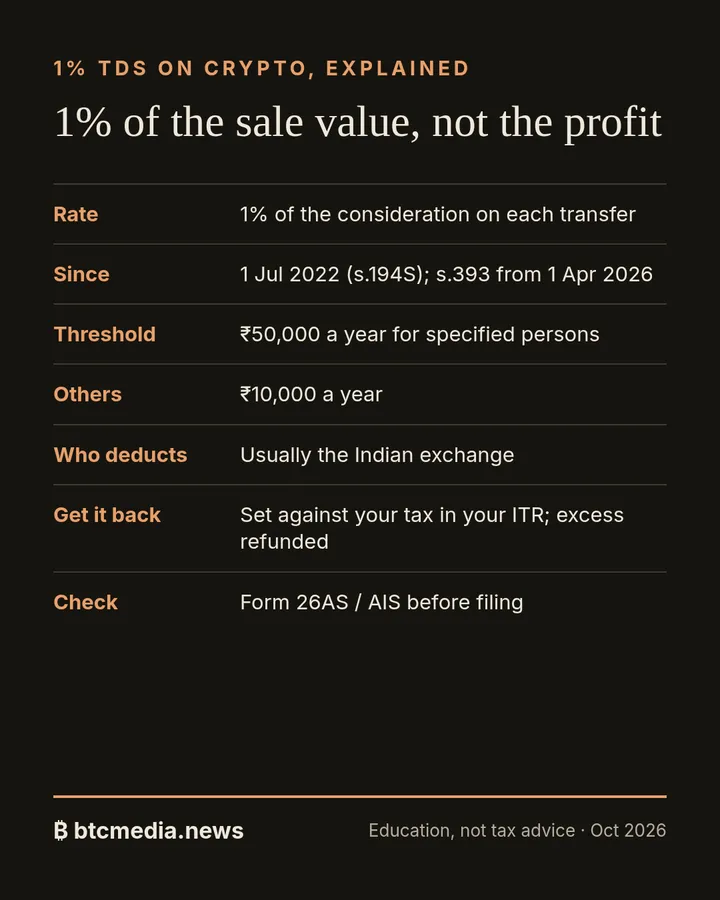
When someone pays a resident for a virtual digital asset (crypto, NFTs and similar), the payer must deduct 1% of the payment as income tax and deposit it with the government. The rule began on 1 July 2022 as section 194S of the Income-tax Act, 1961 (CBDT Circular 13/2022). From 1 April 2026 the same 1% rate sits in section 393(1), Table Sl. No. 8(vi) of the Income-tax Act, 2025 (Income Tax Department).
- Rate: 1% of the consideration, with no surcharge or cess added on top (Income Tax Department).
- On what: the "net" consideration, after GST and charges the deductor levies for its service (Circular 13/2022).
- When: at payment or credit, whichever is earlier. For intraday trading, the department says TDS is deducted each time a trade is squared off.
- No PAN: if you have not given your PAN to the deductor, the rate jumps to 20% under section 397(2) of the 2025 Act (section 206AA in the old Act) (CBDT FAQ).
The ₹10,000 and ₹50,000 thresholds
No TDS is due if the total consideration in the tax year does not exceed:
- ₹50,000 when the payer is a "specified person": an individual or HUF with no business or professional income, or whose business turnover is up to ₹1 crore (professional receipts up to ₹50 lakh) in the previous year.
- ₹10,000 when the payer is anyone else, which includes exchanges.
Once the limit is crossed, the law applies TDS to the whole amount, not just the excess (section 393(1)(a); thresholds in section 393(4), Table Sl. No. 12). In practice most regular exchange users cross ₹10,000 early in the year.
Who deducts it
| How you sell | Who deducts the 1% |
|---|---|
| On an Indian exchange that pays you directly | The exchange |
| Through a broker on an exchange | Exchange and broker, unless a written agreement makes it the broker alone |
| Peer-to-peer / OTC deal where buyer and seller know each other | The buyer |
| Crypto-to-crypto swap | Both sides are liable, since each is transferring a VDA; an exchange may deduct on both legs under a written agreement |
| You are paid in crypto or in kind | The payer must make sure the tax is paid before releasing the consideration |
Source: Income Tax Department, TDS on transfer of VDAs and Circular 13/2022. If you are a non-resident seller, this 1% rule does not apply; other non-resident TDS rules may. We could not find official guidance on how offshore platforms apply this rule, so we do not make claims about them. Tax on your gains is due either way.
The BtcMedia maths: how much cash TDS locks up
TDS comes back to you as credit, but only after the tax year ends and your return is processed. Until then the money is out of your trading account. Take ₹1,00,000, flat prices, no fees, and reinvest everything after each sale. Every sale leaves 99% of what you had:
| Sell trades in the year | Capital still in your account | Locked as TDS credit |
|---|---|---|
| 1 | ₹99,000 | ₹1,000 (1%) |
| 10 | ₹90,438 | ₹9,562 (9.6%) |
| 25 | ₹77,782 | ₹22,218 (22.2%) |
| 50 | ₹60,501 | ₹39,499 (39.5%) |
| 100 | ₹36,603 | ₹63,397 (63.4%) |
| 250 | ₹8,106 | ₹91,894 (91.9%) |
Formula: capital left = starting capital × 0.99trades. About 69 round trips cut it in half. Someone who sells once a day for most of the year gives up most of the money they can trade with, even if they never made a loss. The money is not lost: it is a credit on your PAN. It is just unusable until refund time.
If you instead add fresh money and sell ₹50,000 each time, the TDS is simpler: ₹500 per sale, so ₹25,000 over 50 sales and ₹1,25,000 over 250 sales.
Investor vs trader: who feels it
| Long-term holder | Swing trader | Daily trader | |
|---|---|---|---|
| Sells per year | 1–2 | ~25 | ~250 |
| Share of ₹1 lakh locked as TDS (reinvested, flat prices) | 1–2% | ~22% | ~92% |
| Practical effect | A small credit at filing time | Noticeably less money to trade | Most trading cash waiting for a refund |
| Record-keeping | Light | Moderate | Heavy: every sale is a Schedule VDA row and a TDS entry |
How to get the TDS back
- The deductor deposits the TDS against your PAN and reports it. Specified persons use the PAN-based challan-cum-statement, Form No. 141 (Schedule D), from 1 April 2026 (earlier Form 26QE); exchanges and other deductors use regular TDS statements (CBDT note on Form 141).
- Check it appears in your annual tax statement: Form 168 from tax year 2026-27 onwards, or Form 26AS for earlier years, along with your AIS (Income Tax Department).
- Claim it in the taxes-paid section of your return. It is set against your total tax; any excess is refunded to your validated bank account after processing.
- If a credit is missing, the department's advice is to contact the deductor, as the usual causes are an unfiled TDS statement or a wrong PAN (Income Tax Department FAQ).
Report every sale in Schedule VDA too: see our Schedule VDA filing guide, and work out the 30% tax on your gains with the India crypto tax calculator.
Old Act vs new Act: the names that changed
| Item | Up to 31 March 2026 (1961 Act) | From 1 April 2026 (2025 Act) |
|---|---|---|
| TDS provision | Section 194S | Section 393(1), Table Sl. No. 8(vi) |
| Thresholds | Within section 194S | Section 393(4), Table Sl. No. 12 |
| Challan-cum-statement (specified persons) | Form 26QE | Form No. 141, Schedule D |
| Exchange quarterly statement | Form 26QF | Form No. 142 |
| Annual tax statement | Form 26AS | Form 168 |
| No-PAN higher rate | Section 206AA (20%) | Section 397(2) (20%) |
| Year | Financial / assessment year | Tax year |
The rate (1%) and the thresholds (₹10,000 / ₹50,000) did not change. Which set of forms applies depends on whether the payment or credit happened before or after 1 April 2026.
This guide is general information, not tax advice. For business income, large volumes or foreign platforms, consult a chartered accountant.
FAQ
What is the TDS on crypto in India?
A 1% tax deducted at source on the consideration paid to a resident for transferring a virtual digital asset. It was section 194S of the Income-tax Act, 1961 from 1 July 2022, and from 1 April 2026 it is section 393(1), Table Sl. No. 8(vi) of the Income-tax Act, 2025.
Is 1% TDS an extra tax on crypto?
No. It is an advance collection credited to your PAN. You set it against your final tax when you file your return, and any excess is refunded after processing.
Is there a threshold for TDS on crypto?
Yes. No TDS is due if total consideration in the tax year does not exceed ₹50,000 when paid by a specified person (an individual or HUF without business income, or with turnover up to ₹1 crore or professional receipts up to ₹50 lakh), or ₹10,000 when paid by anyone else, including exchanges.
Who deducts TDS on a P2P crypto trade?
In a direct buyer-seller (OTC/peer-to-peer) deal, the buyer is responsible for deducting the 1% TDS.
What if I have not linked my PAN?
If you do not furnish your PAN to the deductor, TDS is deducted at 20% instead of 1% under section 397(2) of the Income-tax Act, 2025 (section 206AA earlier).
Where can I see the TDS deducted on my crypto sales?
In your annual tax statement on the income tax e-filing portal: Form 168 from tax year 2026-27 onwards, Form 26AS for earlier years, and in your Annual Information Statement (AIS).
Does TDS apply on crypto-to-crypto swaps?
Yes. Both sides transfer a virtual digital asset, so both may be liable; on an exchange, the exchange may deduct on both legs under a written agreement and convert the withheld crypto to INR.
Is TDS deducted when I buy crypto?
The 1% TDS is deducted on the consideration for a transfer, so on an exchange it is cut from the seller's proceeds. Buying alone does not trigger TDS on you; selling does.
Can I get the 1% crypto TDS refunded?
Yes, indirectly. TDS is a credit against your final tax. If the TDS shown in Form 26AS/AIS is more than your total tax liability for the year, the excess is refunded after you file your return.
Will I pay a penalty if TDS was not deducted?
TDS is the deductor's duty (the exchange or buyer), not the seller's. As a seller you still report every transfer in Schedule VDA and pay the full 30% tax plus cess; only the TDS actually deducted is credited.
Which section covers TDS on crypto?
Section 194S of the Income-tax Act, 1961 from 1 July 2022. From 1 April 2026 the same 1% deduction sits in section 393(1) of the Income-tax Act, 2025.
Sources
- Income Tax Department: TDS on payment for transfer of VDAs
- Income-tax Act, 2025, section 393 (Table Sl. No. 8(vi) and 393(4) Sl. No. 12)
- CBDT Circular 13/2022 (22 June 2022), guidelines under section 194S(6)✓ link checked 22 Oct 2026
- CBDT FAQs: higher TDS rate under section 397(2)
- CBDT note on Form No. 141 (replaces Form 26QE)
- CBDT note on Form No. 142 (replaces Form 26QF)
- Income Tax Department: Form 168 / Form 26AS annual tax statement
- Income Tax Department FAQ: TDS credit not reflected in Form 26AS
Also useful: 7 India crypto myths, checked · tax calendar · test your crypto tax knowledge · ask us a question
Join the BtcMedia TelegramGet notified when Indian crypto rules change and this guide is updated. Free.Join →Updates to this page
Last updated . We log every material change. Spot an error? See our corrections policy.
- Added 3 common reader questions to the FAQ, and link-checked badges on sources.
- Hindi edition published (same figures and sources).
- Guide published with embedded 1% TDS calculator, lock-up maths table and old-vs-new Act table.