Is crypto legal in India in 2026?
By BtcMedia Research · Updated · How we source
Also in: हिंदी · தமிழ் · తెలుగు · বাংলা · मराठी
Short answer: buying, holding and selling crypto is not banned in India. It is taxed and regulated for anti-money-laundering purposes, but it is not money in the legal sense, and there is still no dedicated crypto law.
Where things stand
- Legal to own and trade. No law prohibits individuals from holding or trading crypto.
- Not legal tender. Crypto is not money issued or backed by the state. India's official digital currency is the RBI's e-rupee, which is a separate thing.
- Taxed as a "virtual digital asset" (VDA). Gains are taxed at a flat 30% plus cess, losses can't be set off, and a 1% TDS applies on transfers above set thresholds.
- Exchanges are reporting entities. Crypto service providers serving Indians must register with the Financial Intelligence Unit (FIU-IND) and follow anti-money-laundering rules.
The timeline that got us here
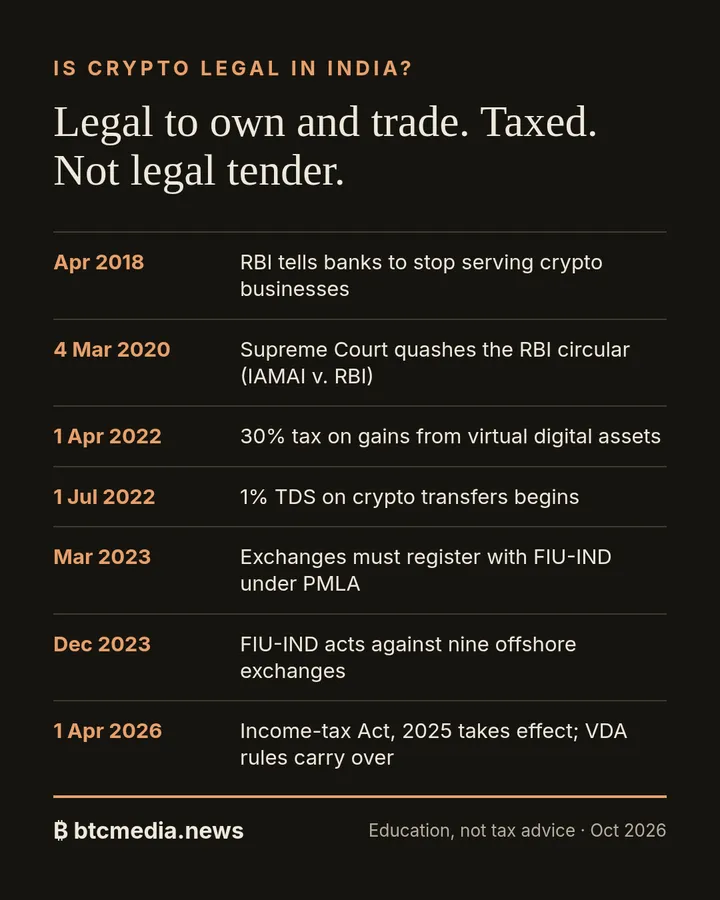
- April 2018 — RBI banking curbs. The Reserve Bank told the entities it regulates (banks, payment firms) to stop dealing in or servicing "virtual currencies". RBI notification.
- March 2020 — Supreme Court sets the curbs aside. In Internet and Mobile Association of India v. Reserve Bank of India (4 March 2020), the Court quashed the RBI circular as disproportionate, reopening banking access for exchanges.
- 2022 — The tax regime arrives. The Finance Act, 2022 created the VDA category: a 30% tax on gains (section 115BBH, from 1 April 2022) and 1% TDS on transfers (section 194S, from 1 July 2022).
- March 2023 — Anti-money-laundering law applies. A Finance Ministry notification brought VDA service providers under the Prevention of Money Laundering Act, 2002, which means KYC, record-keeping and reporting to FIU-IND.
- December 2023 — Offshore exchanges targeted. FIU-IND issued show-cause notices to nine offshore exchanges operating without registration and asked MeitY to block their URLs. PIB release.
- April 2026 — New Income-tax Act. The Income-tax Act, 2025 took effect on 1 April 2026 and defines VDAs in the statute itself. PIB explainer. The 30% rule and 1% TDS carry over under new section numbers (194 and 393, respectively), and a new exchange-reporting framework (section 509) applies from calendar year 2026, as summarised by Mint.
What this means for your money
The practical risk in India is less about legality and more about cost and compliance. A worked example: buy ₹1,00,000 of bitcoin, sell for ₹1,50,000. The ₹50,000 gain attracts 30% tax plus 4% cess, ₹15,600 in total, regardless of how long you held it. A ₹20,000 loss on another coin in the same year does not reduce that bill. Try your own numbers in our India crypto tax calculator.
Using an unregistered offshore exchange adds a different risk: the platform can be blocked, and Indian TDS and reporting obligations do not disappear. Compare registered options on our Indian exchanges page.
What is still unsettled
India has no comprehensive crypto statute covering licensing, investor protection or stablecoins. Until one is passed, the rules above (tax law plus anti-money-laundering law) are the framework. We update this page when anything official changes.
FAQ
Is cryptocurrency banned in India?
No. The RBI's 2018 banking curbs were set aside by the Supreme Court on 4 March 2020, and no law since has banned owning or trading crypto.
Is bitcoin legal tender in India?
No. Crypto is not legal tender. India's state-issued digital currency is the RBI e-rupee.
How is crypto taxed in India in 2026?
Gains on virtual digital assets are taxed at a flat 30% plus surcharge and 4% cess, with no set-off of losses, and 1% TDS applies on transfers above thresholds. From 1 April 2026 these rules sit in sections 194 and 393 of the Income-tax Act, 2025.
Do Indian crypto exchanges need a licence?
There is no crypto-specific licence, but since March 2023 VDA service providers must register with FIU-IND and comply with the Prevention of Money Laundering Act.
Can I use offshore exchanges from India?
Offshore exchanges that do not register with FIU-IND can be blocked; in December 2023 FIU-IND sought URL blocks against nine such platforms.
Who regulates crypto in India?
There is no single crypto regulator or licensing law. Exchanges are supervised for anti-money-laundering purposes by FIU-IND under the PMLA, and crypto income is taxed under the Income-tax Act. Neither SEBI nor the RBI licenses crypto trading.
Do I pay tax just for holding crypto?
No. Tax arises when you transfer a virtual digital asset: selling it, swapping it for another crypto or spending it. Simply holding it is not a taxable event.
Is crypto getting banned in India?
There is no ban. As of October 2026 no law prohibits owning or trading crypto in India. A 2021 bill to restrict private cryptocurrencies was listed for Parliament but never passed, and the government taxes crypto and polices exchanges under anti-money-laundering law instead.
Sources
- RBI notification on virtual currencies (April 2018)✓ link checked 22 Oct 2026
- PIB: FIU-IND show-cause notices to nine offshore VDA SPs (Dec 2023)
- PIB: Income-tax Act, 2025 effective 1 April 2026
- FIU-IND official site✓ link checked 22 Oct 2026
- Mint: Income Tax Act 2025 VDA provisions✓ link checked 22 Oct 2026
Also useful: 7 India crypto myths, checked · tax calendar · test your crypto tax knowledge · ask us a question
Join the BtcMedia TelegramGet notified when Indian crypto rules change and this guide is updated. Free.Join →Updates to this page
Last updated . We log every material change. Spot an error? See our corrections policy.
- Added 2 common reader questions to the FAQ, and link-checked badges on sources.
- Hindi edition published and linked (same facts and sources).
- Guide published. Sources checked: RBI, PIB, CBDT notification 46/2026, Mint.